A Colourful Night Sky
by Mario Abade
When we look at the night sky, we cannot distinguish the colour of each star. At first glance, all stars look white. However, if we register a sequence of long exposure photographs, due to the rotation of the Earth around its own axis, and consequently the rotation of the celestial sphere, it is possible to perceive how colourful the night sky is in reality. In the image below, we can see a Startrail, a product resulting from 279 images taken using ISO 1600, an exposure of 25 seconds each, and edited using the StarStax and Adobe Photoshop 2020 software programs. These images were captured in the sky of Noudar Park, more specifically in Noudar Castle with little light pollution.
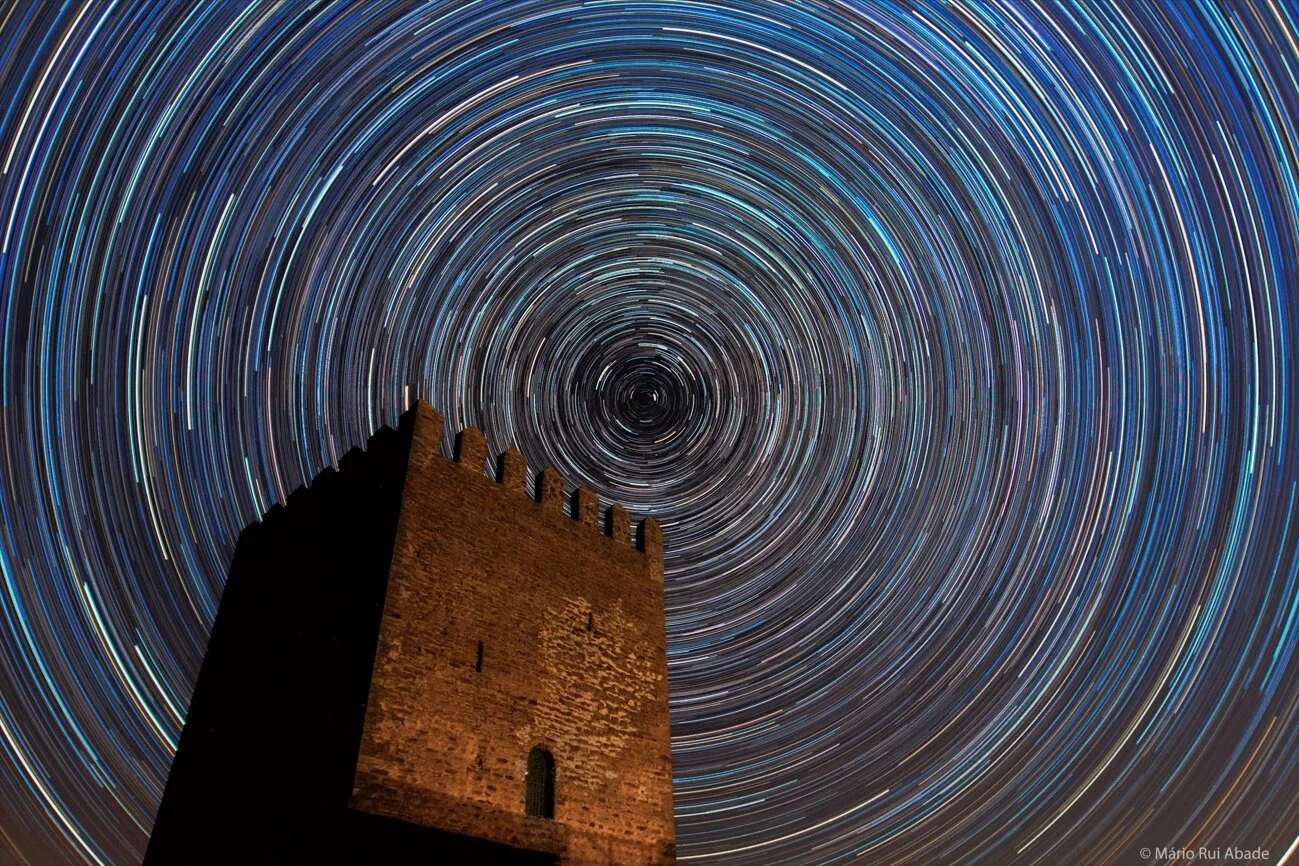
In astronomy, stellar classification is the classification of stars based on their spectral characteristics. Electromagnetic radiation from the star is analysed by splitting it with a prism or diffraction grating into a spectrum exhibiting the rainbow of colours interspersed with absorption lines. Each line indicates an ion of a certain chemical element, with the line strength indicating the abundance of that ion. The relative abundance of the different ions varies with the temperature of the photosphere. The spectral class of a star is a short code summarizing the ionization state, giving an objective measure of the photosphere’s temperature and density. Although stars have no solid surface, the surface temperature designation refers to the region where the concentration of matter begins to fall abruptly. Its core temperatures are much higher. Stars are seen as having different colours depending on their surface temperatures. The higher the surface temperature of a star, the bluer its colour will be. Stars with lower temperatures have a reddish colour. Stars can be classified according to the Morgan-Keenan (MK) system using the letters O, B, A, F, G, K, and M, from the hottest to the coldest, respectively. O-type stars are blue and are the hottest, with very high surface temperatures of approximately 35 000 K or even higher.
They are stars of very high mass, great luminosity and relatively short life. In their spectra, the typical lines of ionized helium, nitrogen and oxygen stand out. B-type stars are bluish-white, with high surface temperatures of around 20 000 K. They are high-mass stars, as well as extremely luminous. The helium lines stand out intensely in their spectra. A-type stars are white, with surface temperatures of about 10 000K. They are of considerable brightness, typically 50 to 100 times more luminous than the Sun, although less brilliant than type O and B stars. Their spectra do not show helium lines, but they display typical well-defined hydrogen lines. F-type stars are yellowish-white, with surface temperatures of approximately 7000 K. These are less luminous than A-type stars and their spectra show weak hydrogen lines, as well as very prominent calcium lines. G-type stars are yellowish-white with surface temperatures of about 6000 K. These are known as solar type stars, because the Sun is of this spectral type.
The spectrum of these stars show weak hydrogen lines and quite strong lines of several metals. K-type stars are orange with surface temperatures between 4000 K and 4700K. In their spectrum, we can distinguish weak lines of hydrogen, as well as spectral lines and bands that are typical of various metals and hydrocarbons, respectively. M-type stars are red, with lower surface temperatures between 2500 K and 3000 K. In the MK system, a luminosity class is added to the spectral class using Roman numerals. This is based on the width of certain absorption lines in the star’s spectrum, which vary with the density of the atmosphere and so distinguish giant stars from dwarfs. Luminosity class 0 or Ia+ stars for hypergiants, class I stars for supergiants, class II for bright giants, class III for regular giants, class IV for sub-giants, class V for main-sequence stars, class sd for sub-dwarfs, and class D for white dwarfs.
The full spectral class for the Sun is then G2V, indicating a main-sequence star with a temperature around 5800 K.
References: Almeida, GD. (2010). As cores das estrelas. In Roteiro do Céu, Almeida GD editor. 5th Edition. Plátano Editora. Almeida, GD & Ré, P. (2003). As estrelas – Temperaturas, tipos espectrais e classes de luminosidade. In Observar o Céu Profundo, Almeida, GD & Ré, P. editors. 2nd Edition Plátano Edições Técnicas.