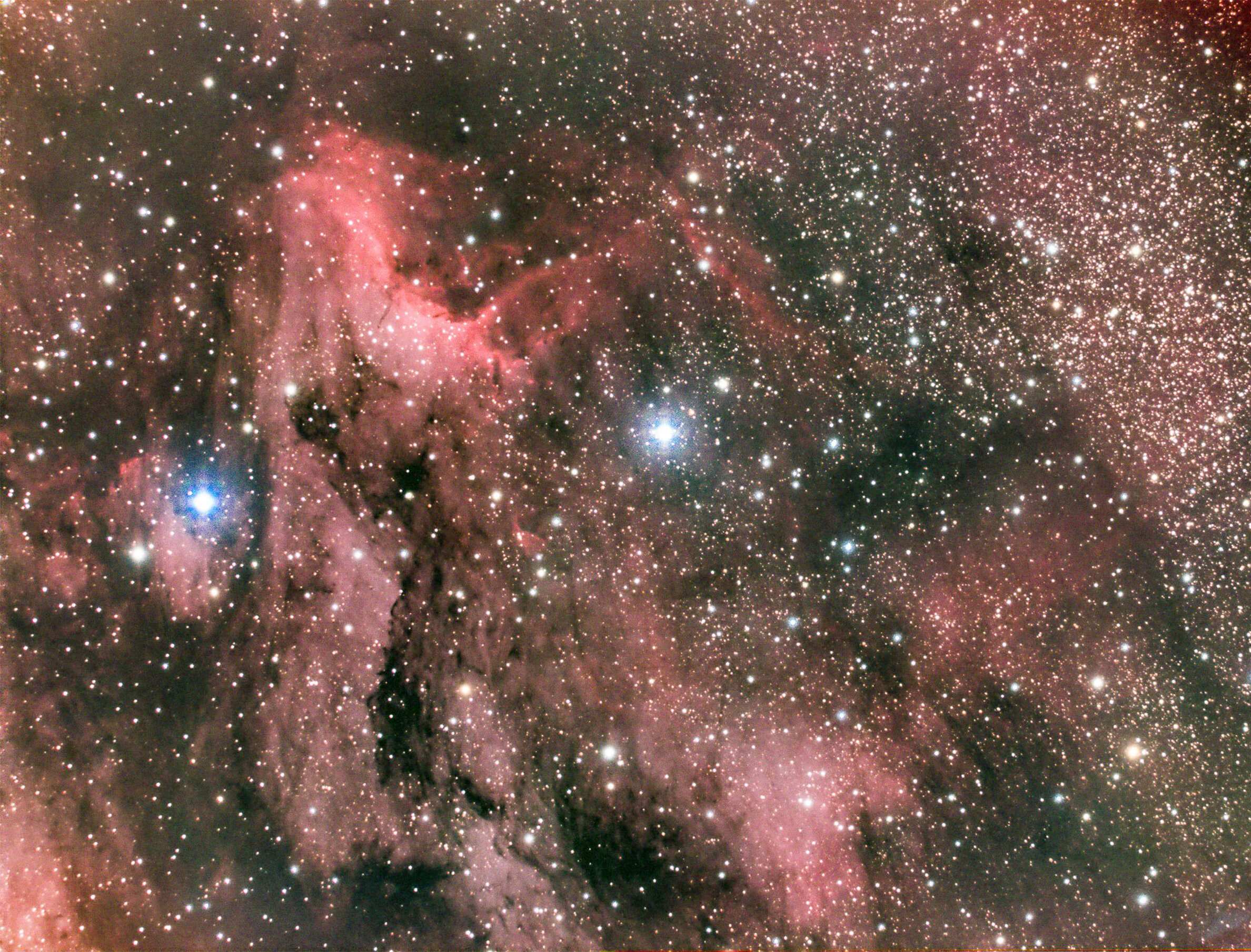
Astrodon Tru-Balance LRGB E-Series
by Tim Cowell
If you are imaging using a mono camera should you spend a little more for your filters at the outset? I think I should have and now I know why, having had some time with a set of LRGB Astrodons kindly loaned by Optical Structures Incorporated.
As an average 'backyarder', I lack the equipment, the requisite skills and sky conditions to perform a clinical trial on this box of classy glass, but the real question is this; what improvements do quality filters offer for ordinary astrophotographers?
The makers say “Astrodon Tru-Balance RGB filters have revolutionized CCD imaging. Their popularity is due to ease-of-use, high optical throughput and great resulting color for galaxies, star clusters and nebulae.”
It was clear and consistent through the mucky summer months of dewy haze and downpours that these filters performed better than my budget set, especially in marginal conditions. What I found was this model of Astrodon filters helped me to produce images that needed less corrective processing. Less problems to start with is fine by me and after all the hard work involved acquiring image data in the first place, I was grateful.
The filters are packaged in a compact case with no pointless or fancy trimmings. The sticker reads – Astrodon Tru-Balance LRGB E-Series, set of 4, NIR blocked, Generation 2, 1.25” Mounted. It is upon drawing a filter from the foam housing you notice that, sturdily made, they are quite tall. Too tall, in fact, for my filter wheel and they fouled the housing. By reversing the filter wheel cover the precious extra millimetres were gained and operations could commence. The black barrel housing is clearly and neatly lettered, declaring Astrodon credentials and stating its property – Lum, Red, Green and Blue.
So, will using Astrodon filters make me a better astrophotographer? Definitely not. Will they give me the performance I'd like to assist my upward climb on the imaging ladder? Yes, and for years and years to come. I did not notice any manufacturing or design defects, nor any halos around stars for instance. I did notice a sharper, clearer image as each sub frame came in for preview.
The extra investment in producing this sort of product is reflected in the up front cost although it seems Astrodon have been busy perfecting their science and eliminating the niggling issues I had thought were due to my operator error or the conditions.
“Generation 2 filters are well known for minimizing or eliminating halos around bright stars due to their construction. The bandpass and blocking layers are all placed on one side of 1/4-wave fused silica glass substrates. The other side has the highest quality anti-reflective coating. As a result, there is virtually no "cross-talk" between the two sides, thereby eliminating halos. We do not need absorptive glass substrates that lower the transmission in order to minimize halos. We keep performance at a maximum. All coatings are made with durable hard oxides using the latest sputtering deposition methods. “
Having already committed to a nice telescope and mono imaging camera we can establish that the target market here is the more serious imager that realises the importance of preserving the light path. It makes sense then, to choose your filters wisely so as not to corrupt your precious photons. Your sensor will thank you.
With identical model telescopes and cameras mounted and having the previews from both 'scopes on a single display, the Astrodon equipped rig showed a sharper, crisper image with better contrast.
In more marginal conditions they always seemed to have an edge, a fraction better? More than a fraction. It looked to me as though someone had been kind enough to give each sub a little tidy up before presenting the perfected image.
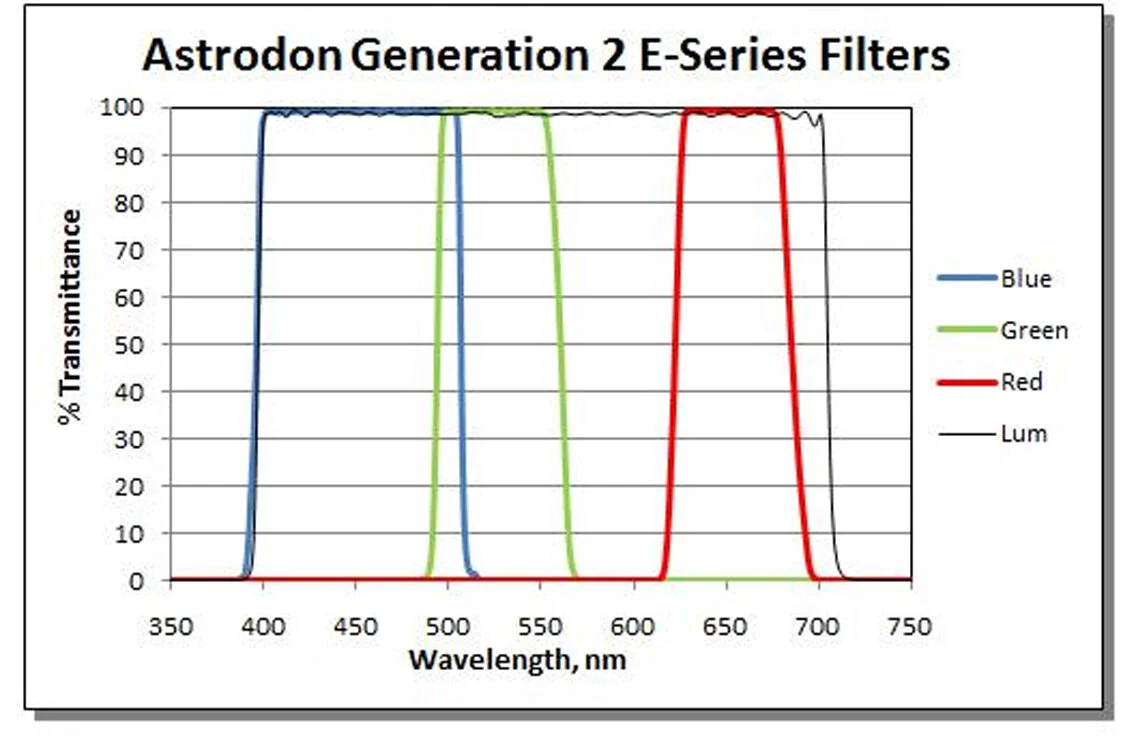
“The E-Series filters are also designed to minimize the leading source of local light pollution from high-pressure sodium street lamps. Their yellow color occurs in the 580 to 600 nm region. This is the region in the E-Series BETWEEN the green and red filters that is not passed to the STX detector. The high-performance luminance filter blocks both UV and Near-Infrared (NIR) light, and is supplied with the RGB filters as an LRGB set.”
Since these are 1.25” filters they get used on my portable set up, so having filters that work across a broad range of conditions suggests even more value for money and less hassle. Despite the ever fluctuating exchange rates this Gen 2 set is keenly priced in the UK.
They appear to work well with the '1600' size sensor on my ZWO ASI 1600 MM Pro and even at this level of excellence represent a fraction of the cost of the camera, yet are such a vital component.
Ultimately this experience reinforced the saying buy cheap and buy twice. There is nothing 'wrong' with my budget filters and in better hands I have no doubt they can work beautifully. I need all the help I can get in this tricky pursuit and found the effect of a more carefully cleansed light cone hitting the sensor produced a better outcome for me.
Astrodon Tru-Balance Generation 2 Filter Features
• RGB filters designed to produce true color for galaxies and stars based upon a G2V (sun-like star) white point.
• Equal exposure time for each RGB filter leads to equal fluxes and equal color weights (combine ~ 1:1:1).
• Correct blue-green color for OIII in plane-tary nebula with 1:1:1 RGB color weights for correct star color.
• Two LRGB designs; E-Series for full-frame, and I-Series for Interline CCDs.
• Deep red filter in E-Series brings out HII regions in galaxies and better definition of H-alpha in emission nebula.
• All filters transmit an amazing 98% in their passbands for the highest perform-ance available.
• All filters are UV and NIR-blocked. No extra filters are needed.
• Breakthrough design eliminates halos around bright stars.
• Hardest optical coatings on 1/4-wave fused silica substrates for durability.
• Coatings extend to the edge (no uncoated rims that need to be blocked) and no edge-sealing is required.
• Light pollution suppression included in the design.