
Adrien Mauduit
https://www.nightlightsfilms.com/

ADRIEN MAUDUIT
M.Sc., Photographer, cinematographer, visual science education & communication coordinator, Science author, owner at NLF
My Name is Adrien Mauduit. I am a thirty-year-old French astrophotographer, cinematographer, science communicator and owner at Night Lights Films. I live in Norway where I photograph the northern lights, but I also travel the world in search of the darkest places to capture the beauty of the cosmos. It all started when my grandpa gave me an old Minolta camera that had been passed down from his father, as a gift for my birthday when I was 10. I started getting so excited about it that I instantly felt the urge to go outside and take my first shots. It wasn't the easiest hobby to take up when you are so little because I had to hold an old metallic 200mm lens attach to a rock solid body! I had always been passionate about nature, birds, plants and all sorts of creeping creatures and I attempted to capture and photograph everything that wiggled around. As time passed by and interests slightly shifted, my teenage years unconsciously -or not?- pulled me away from photography and I had never really touched a camera ever since. Until 2013!
Who would have known that my so hectic teacher job in a little Danish province school allowed me to go out and take pictures? Besides my love for animals and plants, I also found a passion for grander things, like the night sky and the universe. I bought myself a new Canon EOS 70D camera along with some start-up kit lenses, and started shooting the night sky. 'Hmmmm not so easy', I realized, looking at my horrendous and underexposed first pictures. Good thing for me that we live in the information technology age and that I can find any tip I needed on the internet. I rapidly got the hang of it but needless to say that I went through a lot of challenges and made a bunch of mistakes at first. Not too hard now, you just need patience, a sturdy tripod, a timer remote and a lot of batteries!
We are now in 2019 (published in Dark Sky Travels in 2019) and six years after I started touching a camera again, it feels like I can't get my hands off it. It's an addiction. Especially when I get the rare occasion of a clear night sky or a solar storm! But I took the bull by the horns and I added to my collection an equatorial mount (for night sky objects tracking) and the new incredible 42 megapixels Sony alpha 7rII that allows me to shoot in 4K, a Sony a7s, two modded Canon 6D, along with a wide variety of objectives that are much better for astrophotos. However all of this is not 'just for the love of photography': I need to feel the connection with nature and consider my tiny place in the vastness of the universe. It's a way for me to keep myself grounded, humble, and somehow appreciative of my somewhat insignificant role in the course of the biological and astronomical cycle. My goal is to try and take incredible and unseen pictures, because I am always amazed at the small and big things that we don't really regard in our daily lives. Making gigantic tiny while making microscopic huge; 'Discover, visualize the cosmos' - here is my motto. I am mostly interested in landscape, astro, deep-sky, and macro photography, and I have also developed a passion for time-lapse, and especially astrolapse. The purpose of my mission is also to educate myself first, while passing the knowledge and awareness down to other people. There are so many compelling and sensitive subjects at stake here: conserving our nature and the environment, protecting our precious ressources, fighting pollution (and especially light pollution), promoting space and atmospheric sciences and discoveries. Working with visual science, my devotion goes to making the invisible visible through my lens to share it with the world. In many ways we have forgotten where we come from and how to really appreciate it. My work is a way for me to express myself and a hope to give back what our hectic lives have buried deep beneath cement and light pollution. Subsequently I am trying to develop new ways of visualizing our night sky using close-up views of the phenomena occurring in it (aurorae, noctilucent clouds, deep-sky objects, meteor shower, eclipses etc...) . The content that I work on encompasses mainly short weekly videos (time-lapse or real-time) about astro-events, but also bigger projects like themed documentary videos showcasing our world in an artistic and still scientific way. That goes without saying that I also love helping people and teach them what I know, so I started a series of tutorials that are step-by-step complimentary courses (available at www.nightlightsfilms.com or on my social media handles).
After earning a B. Sc. and M. Sc. in environmental sciences in France, I became a high School science teacher in Denmark where I picked up astrophotography. After a long journey of self-teaching, I moved back to France hoping to make this my profession. After a hard year of financial struggle and mass content creation, I found a guiding position at the aurora borealis observatory on Senja island Norway. I now work as a seasonal full-time aurora guide there, and I started my own company Night Lights films. I work as a full-time freelance astrophotographer and cinematographer year-round, but travel the world during the off-season to get pictures and timelapses.
Northern Norway:
The best place for nature and aurora lovers, but not only!
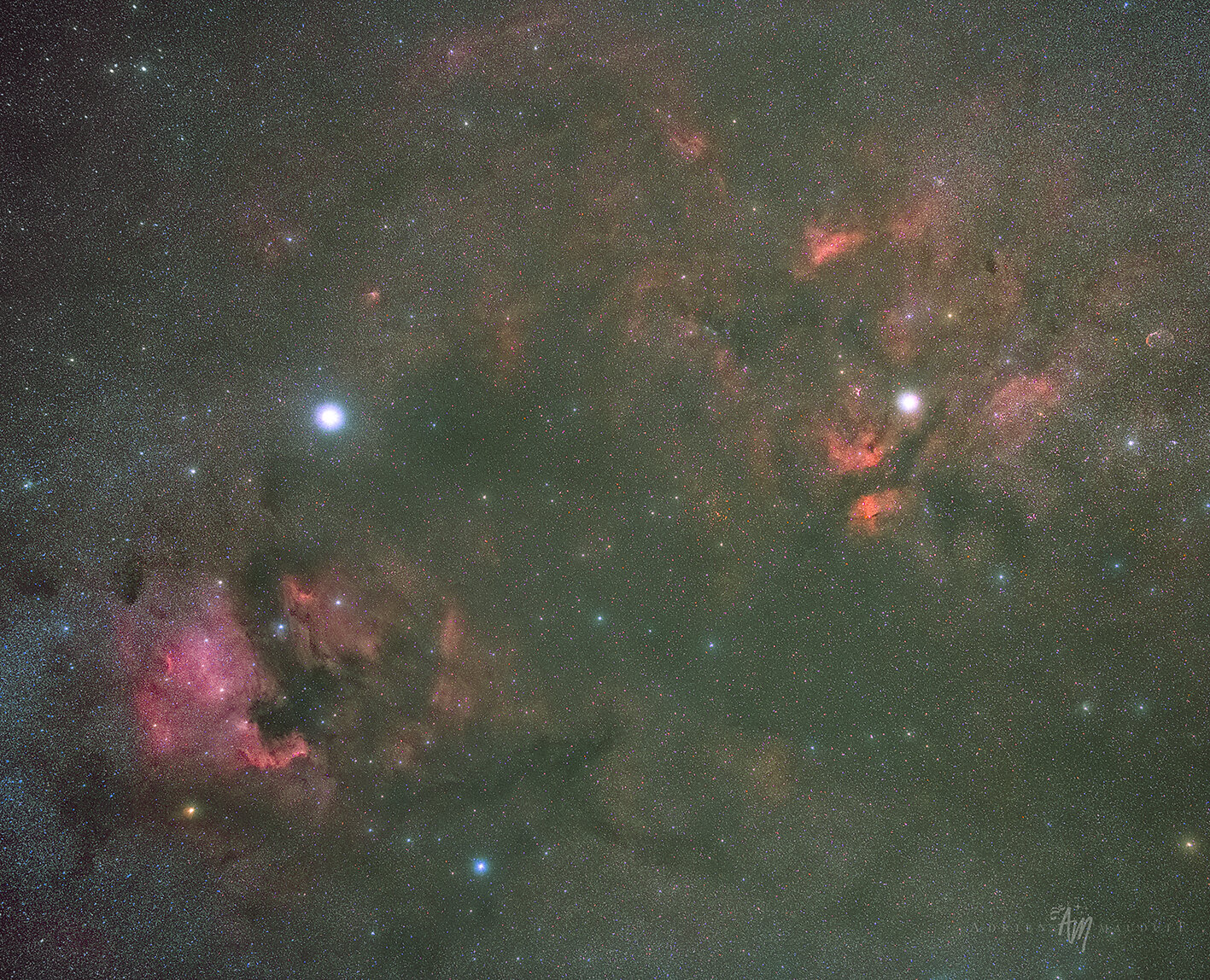
Cygnus
In my career as astrophotographer and nature cinematographer Ihave visited many places, especially northerly ones. My endless quest to capture the best northern lights in the world has brought me to many places like Canada, Iceland, Sweden, Norway, Finland. Among all these gorgeous places only one stood out because of a combination of crucial factors that makes the aurora experience unforgettable: Senja island, Norway. Now specializing in the night sky generally speaking I needed to land in a place that was also rocking for other things to capture like our moon, beautiful sunrises and sunsets, but most of all the stars! Being a bit skeptical at first knowing that the bright light of the aurora would annihilate any chance of capturing deep-sky astrophotography, I tried to point my DSLR’s to the milky way and other things to test that theory. Boy what a surprise… Believe it or not the image above was taken in September at the start of my aurora season from the Aurora Borealis Observatory. The aurora was rather faint in the North so I tried to make the most of the time with our guests and showed them the wonders of the night sky. It’s the red North American Nebula and Sadr regions that you can see better here on a wider angle view taken above Mount Segla in Northern Senja in January:
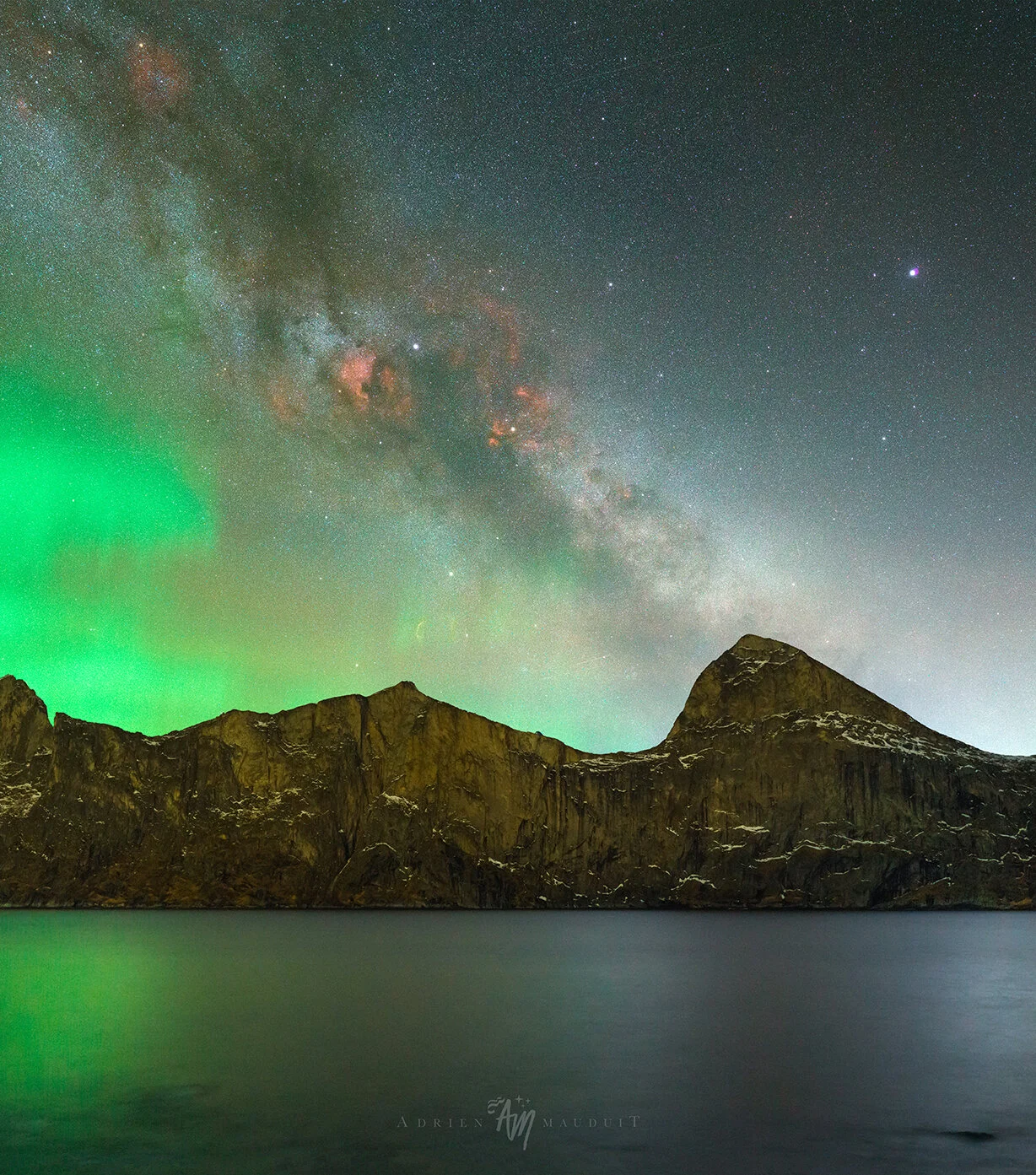
Self-portrait at Tungenesset on Western Senja under the milky way a nd the aurora at the same time. Single shot (Canon 6D + Sigma 14mm fq.8 Art, tracked).
As an astrophotographer my main concern when taking pictures is light pollution. I was also very doubtful before discovering Senja island because if you look on any Light Pollution map, Northern Norway has a bit of light pollution. However speaking from experience with light polluted areas and how a light polluted picture looks like, I can tell you that the quality of the skies over Senja is actually excellent. To be able to pick up the red H-alpha color of the nebulae in the sky in a single picture you need quite pristine skies. And Senja has them! The observatory is built 15 minutes from a small town called Finnsnes. There is a bit of light pollution emanating from it but the observatory is far enough away from it. Besides there are few isolated towns and villages but the major cities like Tromsø are at a safe distance. So when you book your next stay at the aurora observatory with us be prepared for an all-round night sky show, especially if you are ordinarily living in the city! The best time to see the brightest part of the milky way on Senja is September/October.
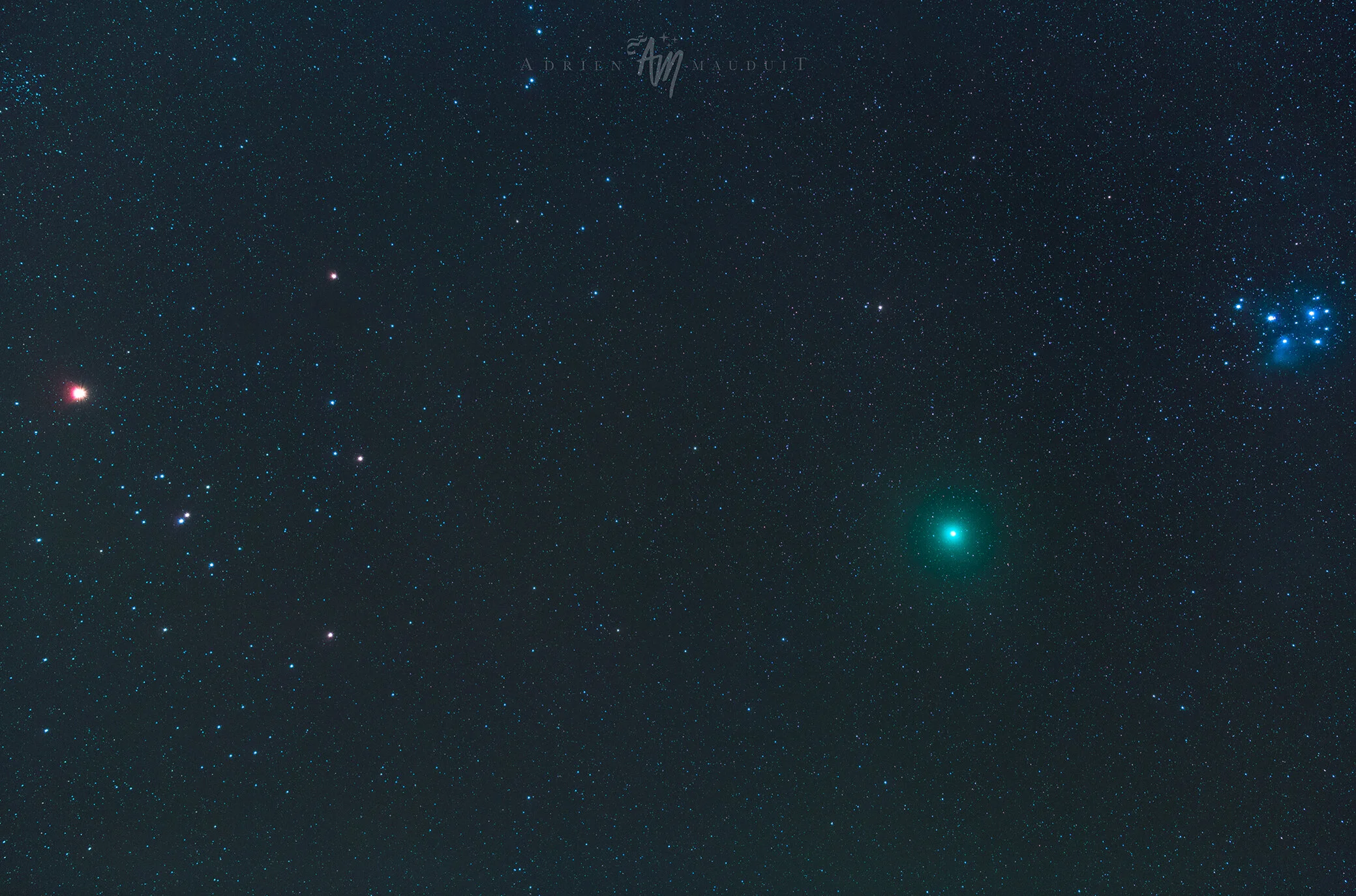
Comet Wirtanen (green) stuck between the Pleiades or ‘Seven Sisters’ (blue cluster of stars) and the Hyades (arrow head pointing down on t he left hand side). Taken from the observatory (Stack of 25 picture with Canon 6D + Samyang 135mm f2)
Why Senja island?
Northern Norway is known for its unforgiving winters, oceanic storms and untamed equinoxes. Nonetheless there is a place where the weather is consistently better than others: South-East Senja. Indeed aurora watching requires clear skies. A few clouds are not an issue and we generally say that as long as there are gaps, you can see the lights. However, like many polar regions, Northern Norway’s winters can be quite harsh. The country is at the confluence of two main air currents: lukewarm and humid versus cold and dry.
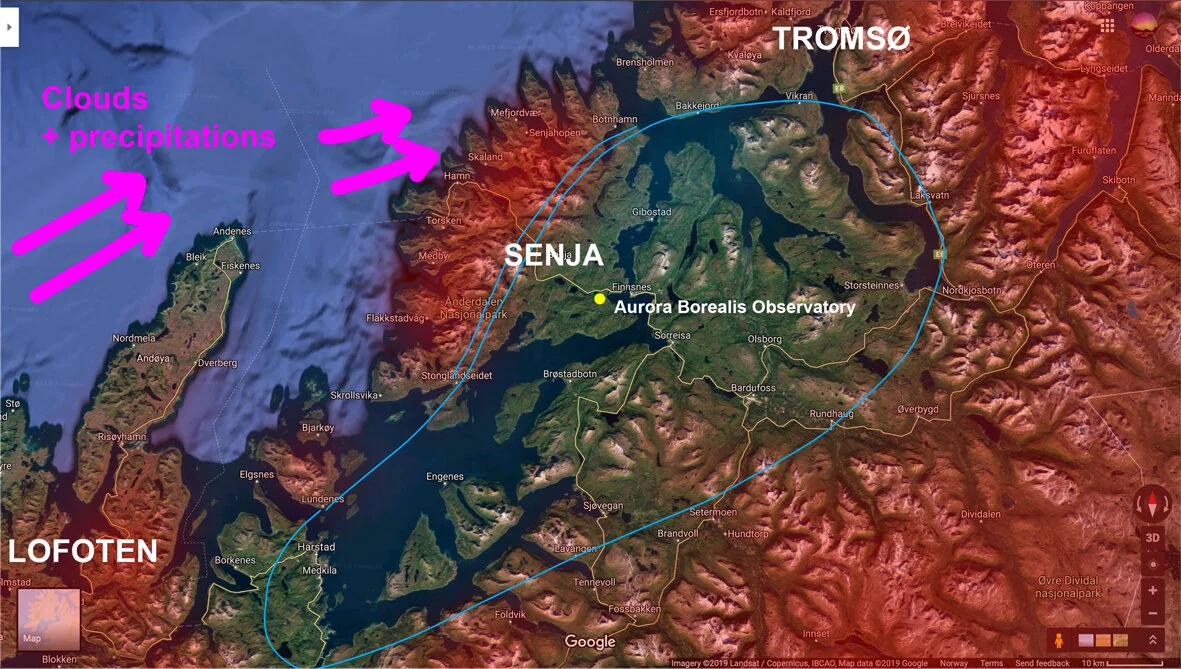
There exists a trough surrounded by high mountains in the Troms region. This trough extends up to Eastern Senja (especially South-East where the Observatory is located), the Finnsnes peninsula and towards Sørreisa – Bardufoss. It is mainly constituted of lower and flatter hills close to the fjords. Believe it or not this difference in altitude creates more air pressure in the trough and allows clouds to dissipate often, generally at the end of the afternoon and towards the night. There is a rather quite high ridge of mountains on the outer side of Senja, which continues around Tromsø in the North and Lofoten in the South. It acts as a shield and blocks a lot of the humid influence from the South-West. Clouds often cling to those high summits making aurora visibility rather poor in the fjords. If you stay around Eastern Senja you will have more chance of finding clear skies and seeing the Aurora! This microclimate is the reason why we have built the observatory there. When storms are too powerful, we still have bad weather though. There is literally nothing we can do. In total honesty the 2018-2019 has been one of the most terrible to date weather wise. However even then our guests saw the aurora way more than people in Tromsø or Lofoten have. As a matter of fact more than a lot of other locations around the world. The sky usually tends to clear up just in time to gaze upon the aurora explosions! More than 9 guests out of 10 saw the aurora this year and many were treated to fantastic colorful shows. And it’s mostly due to the Senja microclimate! One more reason to book at the observatory for your next aurora adventure!
My favorite aurora spots on Senja island
Senja island is Norway’s second largest island and called Norway in miniature. It possesses all the landscapes of Norway and thus countless incredible places to watch and take pictures of the northern lights. Whether you are after hilly valleys, wild patches of boreal forest, endless fjords with jagged-edged mountains rising from the sea, white-sanded beaches, fresh-water lakes or highlands, Senja has got it all. Consequently it doesn’t matter where you stop, you will always get this postcard-quality scenery. However here are my 5 favorite places to shoot the aurora from.
1) Tungenesset and Ersfjord
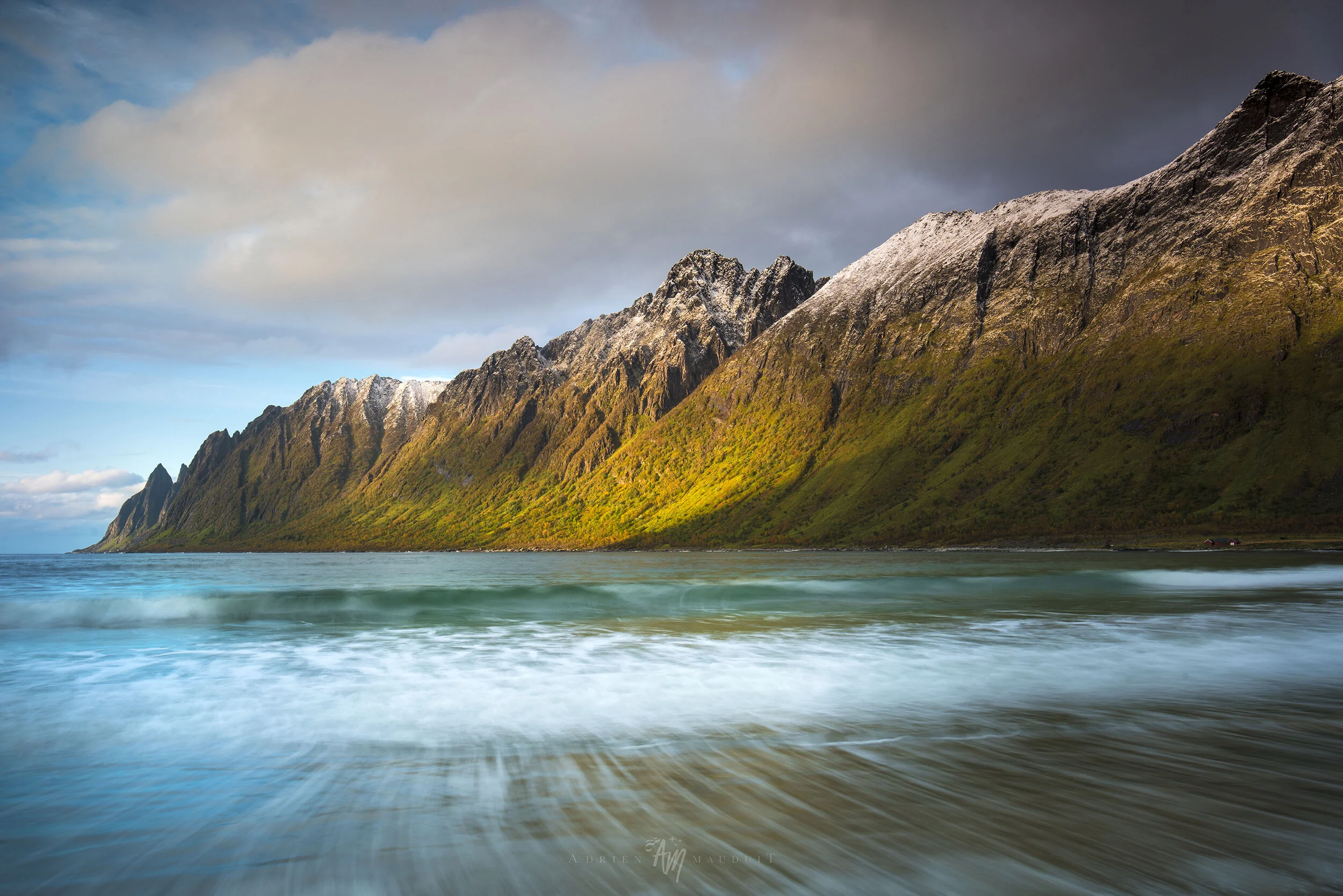
Following the road west, you will come by Medfjord and another fishing village worth stopping at: Senjahoppen. However you’re just a few kilometers away from arguably the most beautiful and picturesque spot on Senja. After driving through a tunnel, you arrive at the bottom Ersfjord. It’s quite a narrow fjord with high mountains protecting it from the dominant winds, and it’s not rare to have higher temperatures there. What a surprise when you get closer to the shore. Ersfjord village harbors a u-shaped white-sanded beach! In the summer time it is packed with people relaxing and camping. The beach calm turquoise waters make you feel like you are somewhere in the Indian ocean but the mountains remind you that you’re still within the arctic circle! Continuing southwest for 2 kilometers, you will have to stop at the photographers’ paradise of Senja island: Tungenesset. The shore offers a walk on polished rocks that harbor countless puddles. When weather conditions are favorable, you can get the reflection of the Devils’ teeth mountains in the still water.
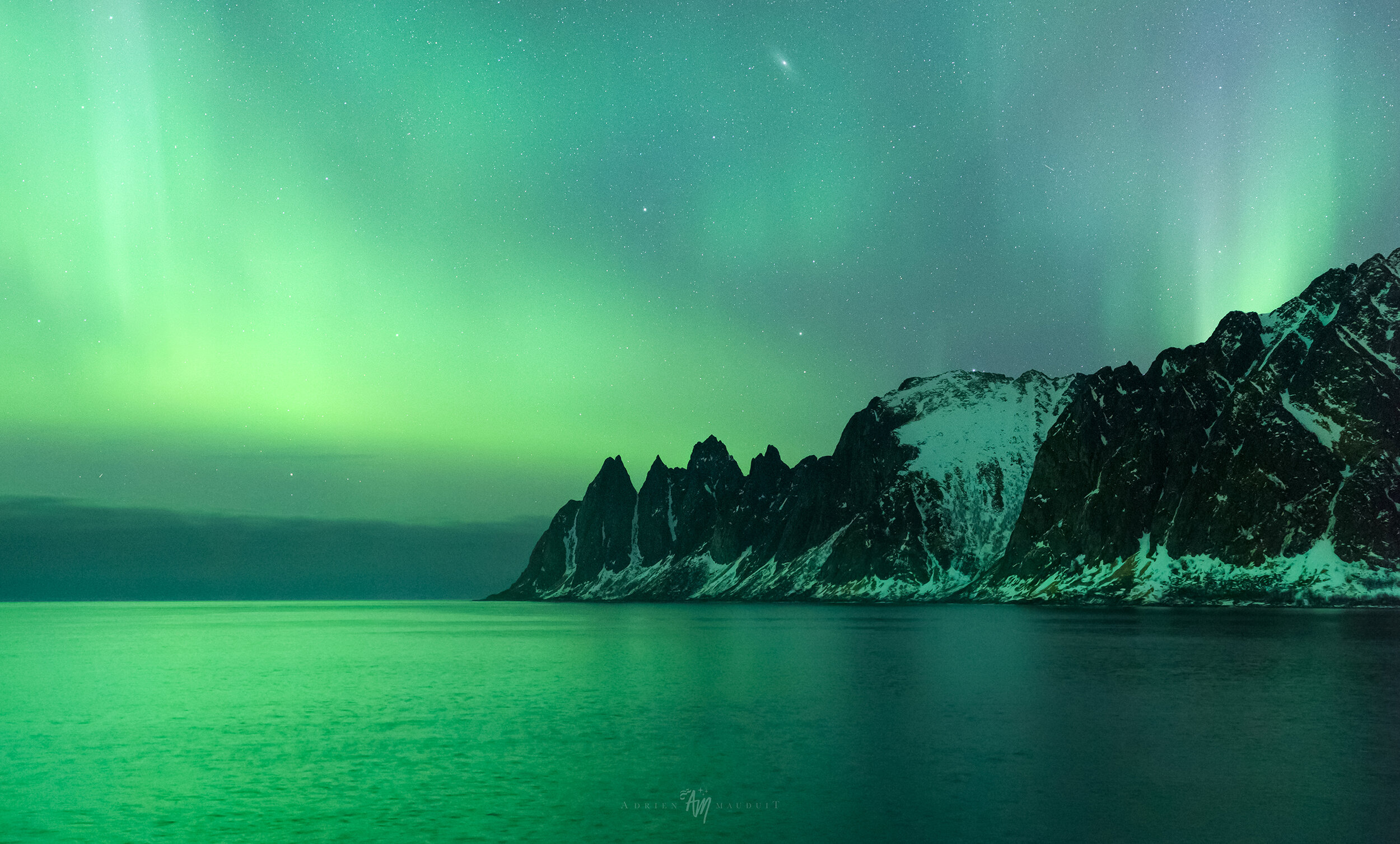
mountains remind you that you’re still within the arctic circle! Continuing southwest for 2 kilometers, you will have to stop at the photographers’ paradise of Senja island: Tungenesset. The shore offers a walk on polished rocks that harbor countless puddles. When weather conditions are favorable, you can get the reflection of the Devils’ teeth mountains in the still water.
2) Mefjord
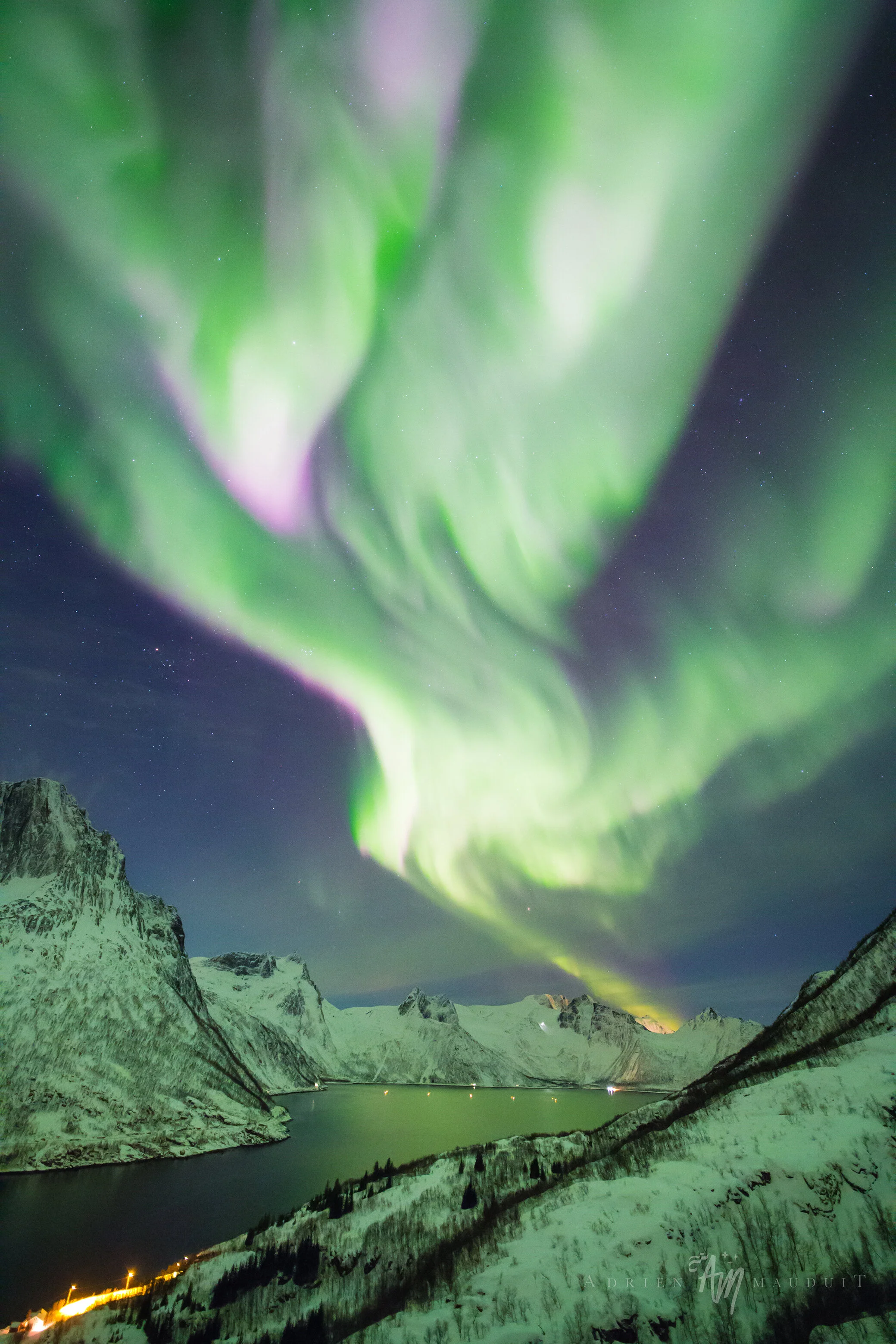
Mefjord is Senja’s longest fjord. It’s part of the island’s northern fjords and has a north-northwest direction, perfect for the aurora. You access it by the 86 road from Finnsnes, just before getting to Senjahoppen. You can park on the side of the road and walk for five minutes to a view point overlooking this majestic narrow valley filled with deep water and salmon farms. From up there, you can surely enjoy the ‘hight’ of the aurora as it paints all the mountains green!
3) Sifjord and the Valley of Trolls
Return back the same way on 86 towards Finnsnes. After two dozen kilometers you will find a small road on your right. It will first take you to the high plateaus of Senja. After a tunnel, you will land in what we call the Valley of Trolls, and for good reasons! It’s a very narrow valley stuck between two high mountain ridges. There the rocks are a bit more unstable and small to medium size boulders come down and strew the side of the road. Moss and vegetation progressively grow on them, making them look like hair on a troll’s head. The valley’s road zigzags down to Sifjord, and from there you can visit the 5 different fjords of the west, offering and impressive array of scenic views.
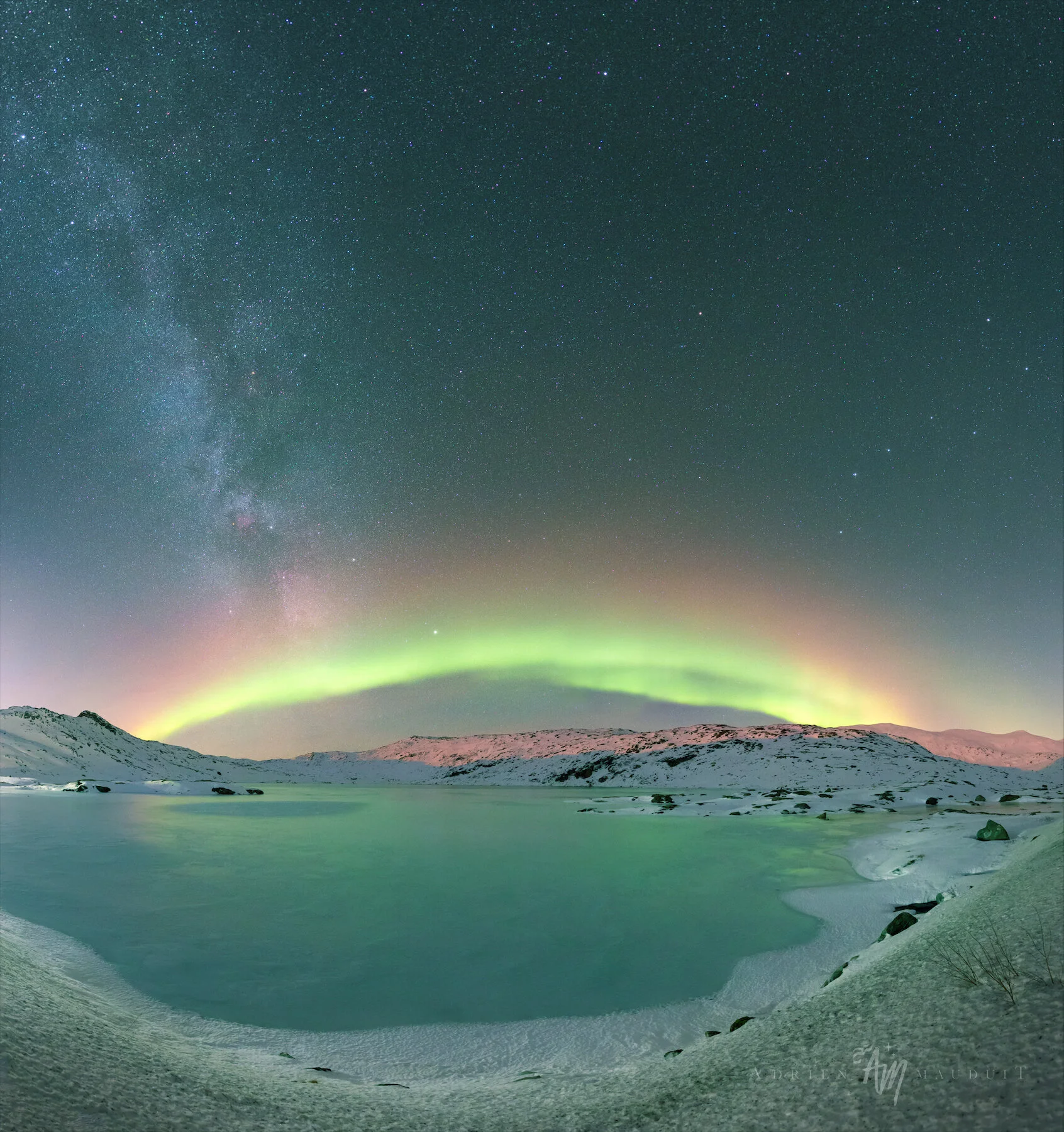
4) Stonglandseidet and Southern Senja
Back on your steps and onto road 86, you can make a right on 860 right before entering Silsand. This will take you to the south part of the island. The south is less popular but no less stunning. It’s a total change of vegetation and landscape. The small road winds up and down along Senja’s ‘golden coast’. This side of the island gets the most light and sun, especially in the wintertime so if you are a photographer in search of astounding red sunsets, south is where you want to go. Plus it is very likely that you will cross path with wildlife such as eagles, moose and reindeers. Finally you arrive at Stonglandseidet.
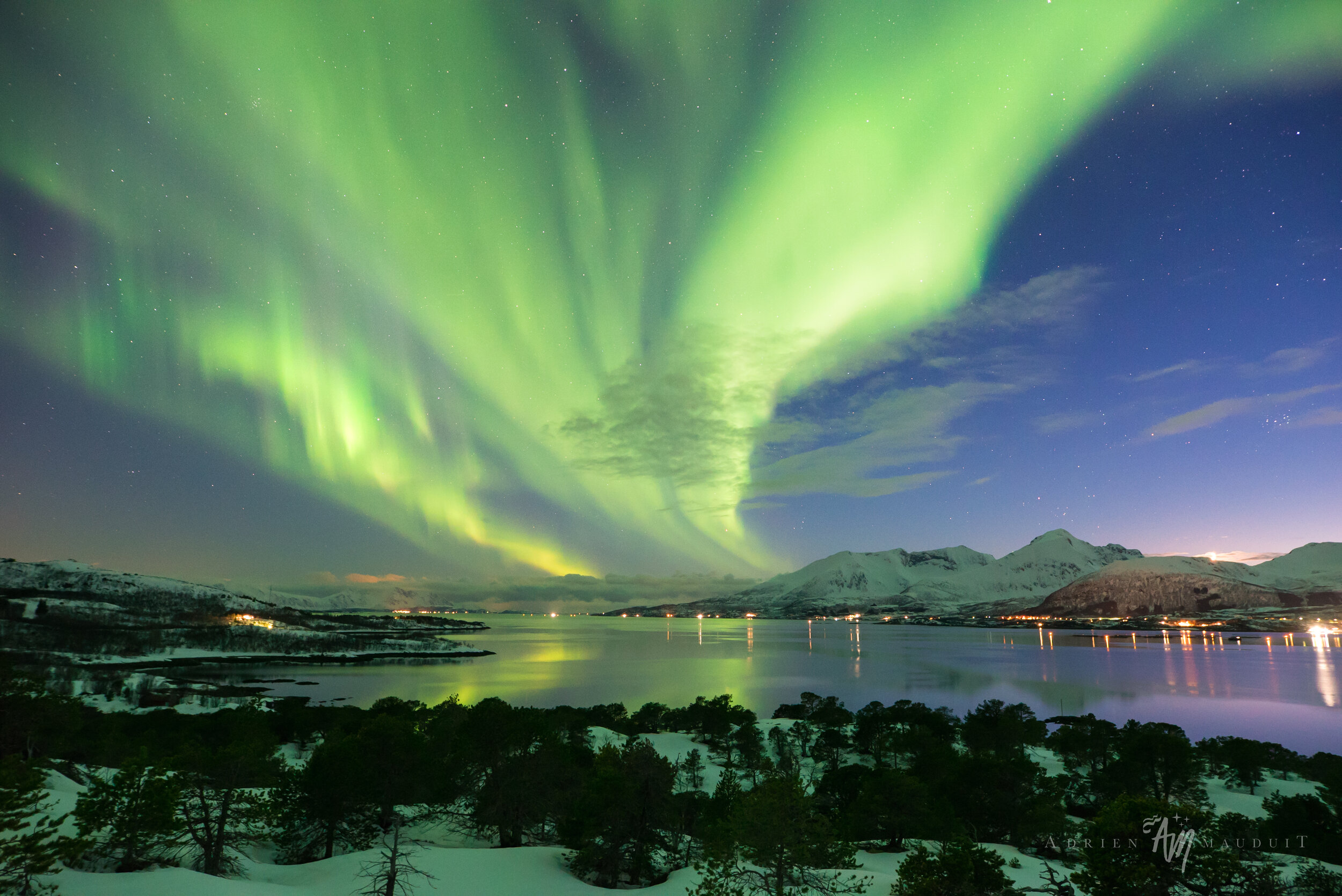
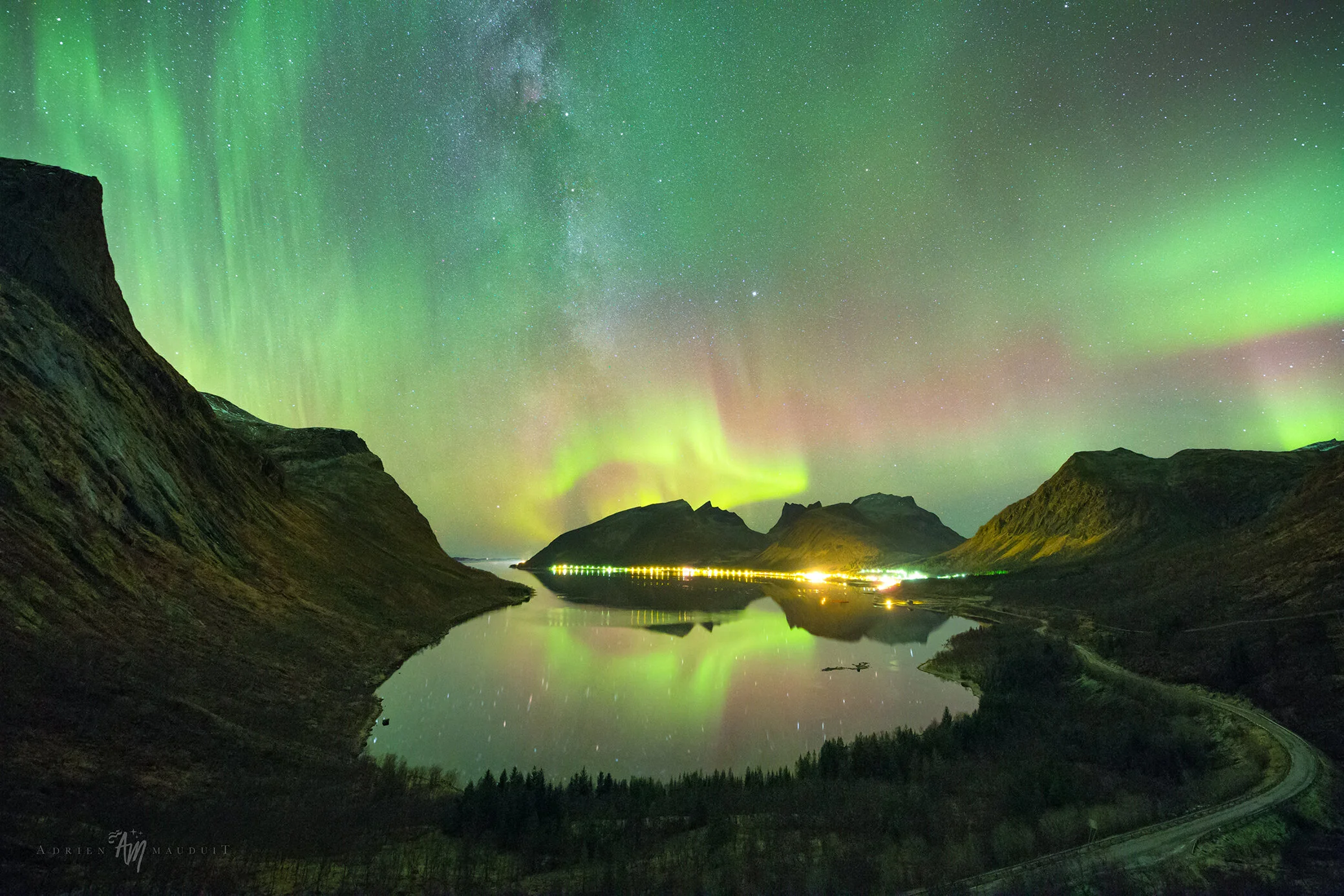
5) Bergsbotn
Bergsbotn is the bottom of the Fjord of Berg, on the 86 road going towards Finnsnes from the Western fjords. It also has a single but famous viewing platform. The community there built a suspended bridge that lets you watch the sunset or the aurora from a cool perspective. The fjord of Berg is quite large and circular. That’s why the bridge is so popular! If you are to take aurora pictures, you want to remain on firm ground however, as the constant wind will cause the bridge to slightly swing and degrade the quality of your pictures!
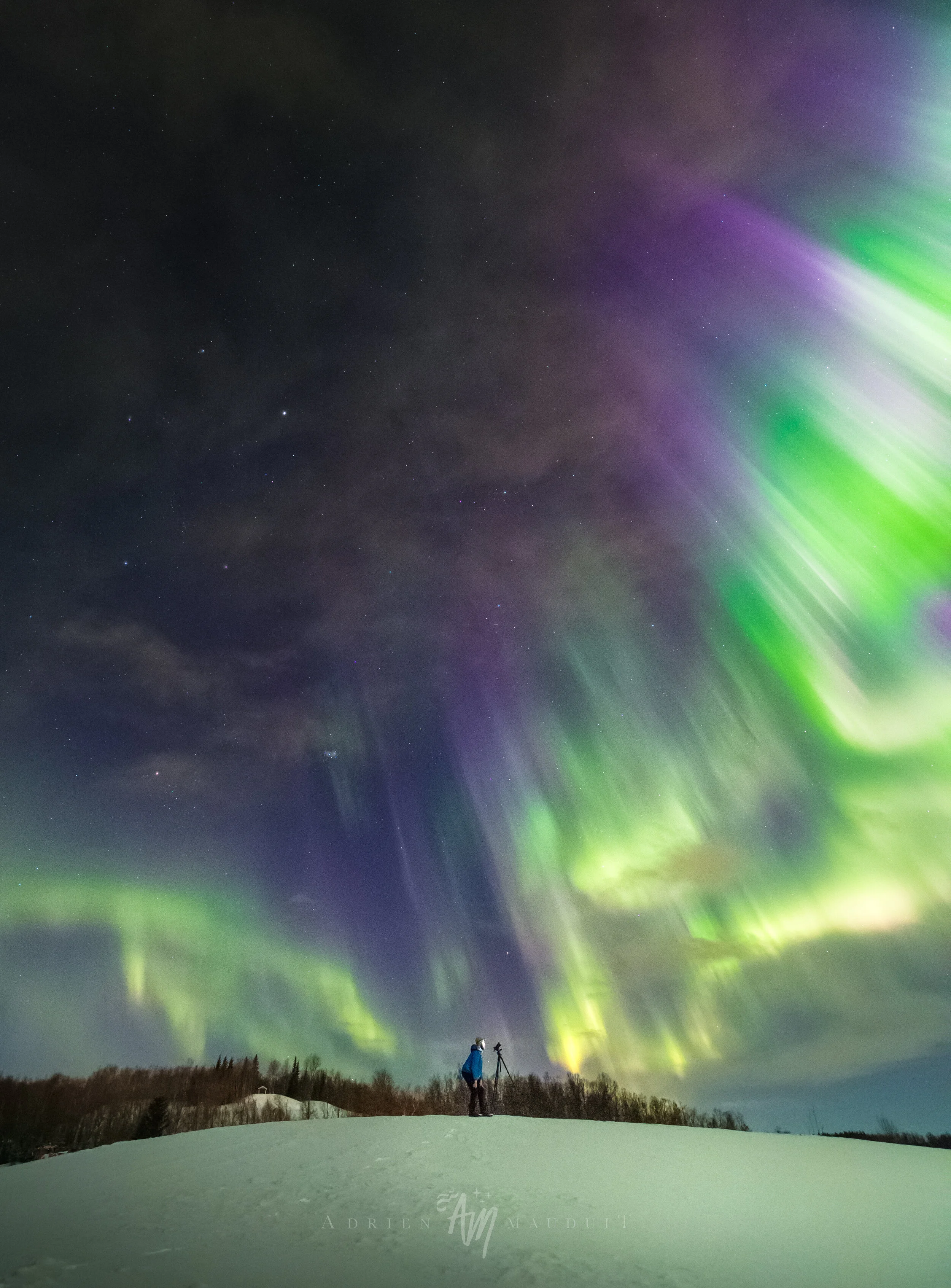
The Photographer and the Lights
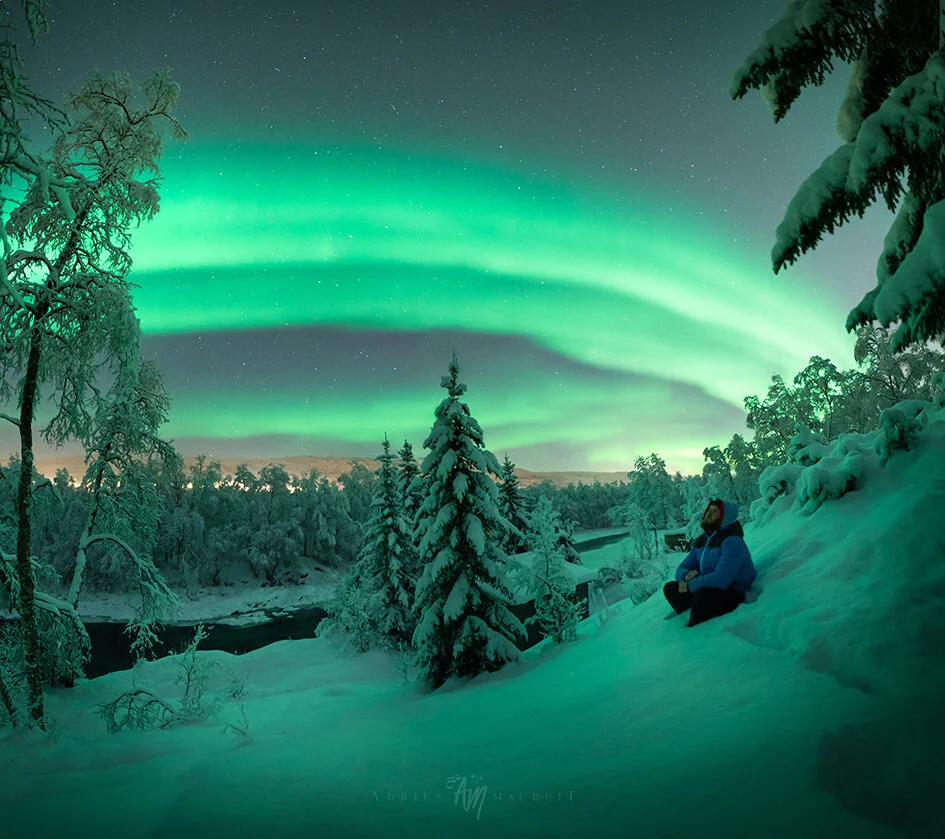
This picture taken from the Aurora Borealis Observatory is one of this year’s favorites. It shows how much the aurora can light up the landscape. I love how the right-hand side is lit up by the huge colorful beams while the left side is in the shadows. You can also see my face being lit up by the aurora. What a spectacle it was!
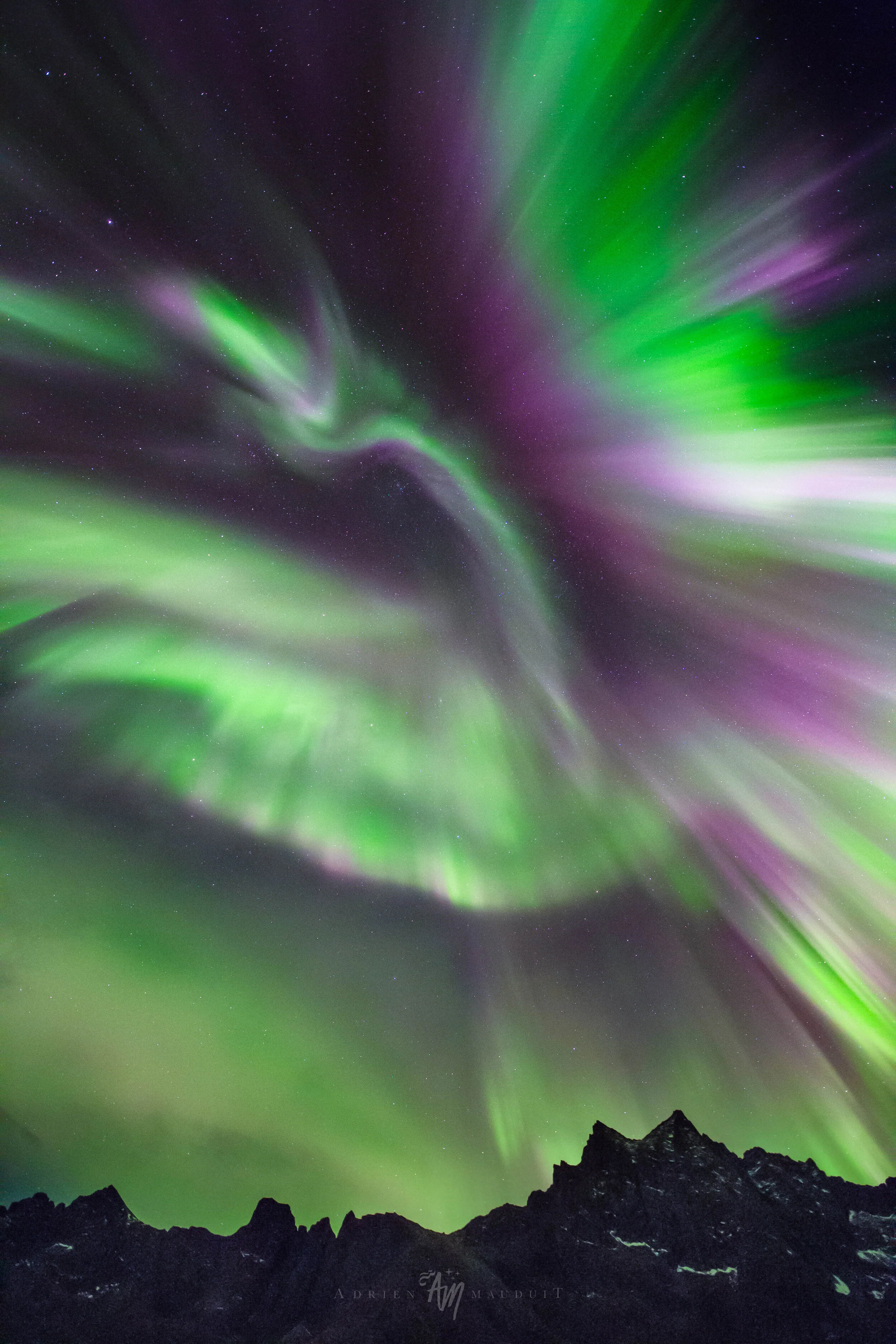
Phoenix rising I just couldn’t believe what I had just caught when I looked at the back screen of my camera right after a humongous aurora exploded over Medfjordvær on Senja, Norway. For one frame only the rapid movement froze into a giant phoenix seemingly rising up from the mountains. It is surely the wildest aurora shape I have captured in my career so far! WOW.
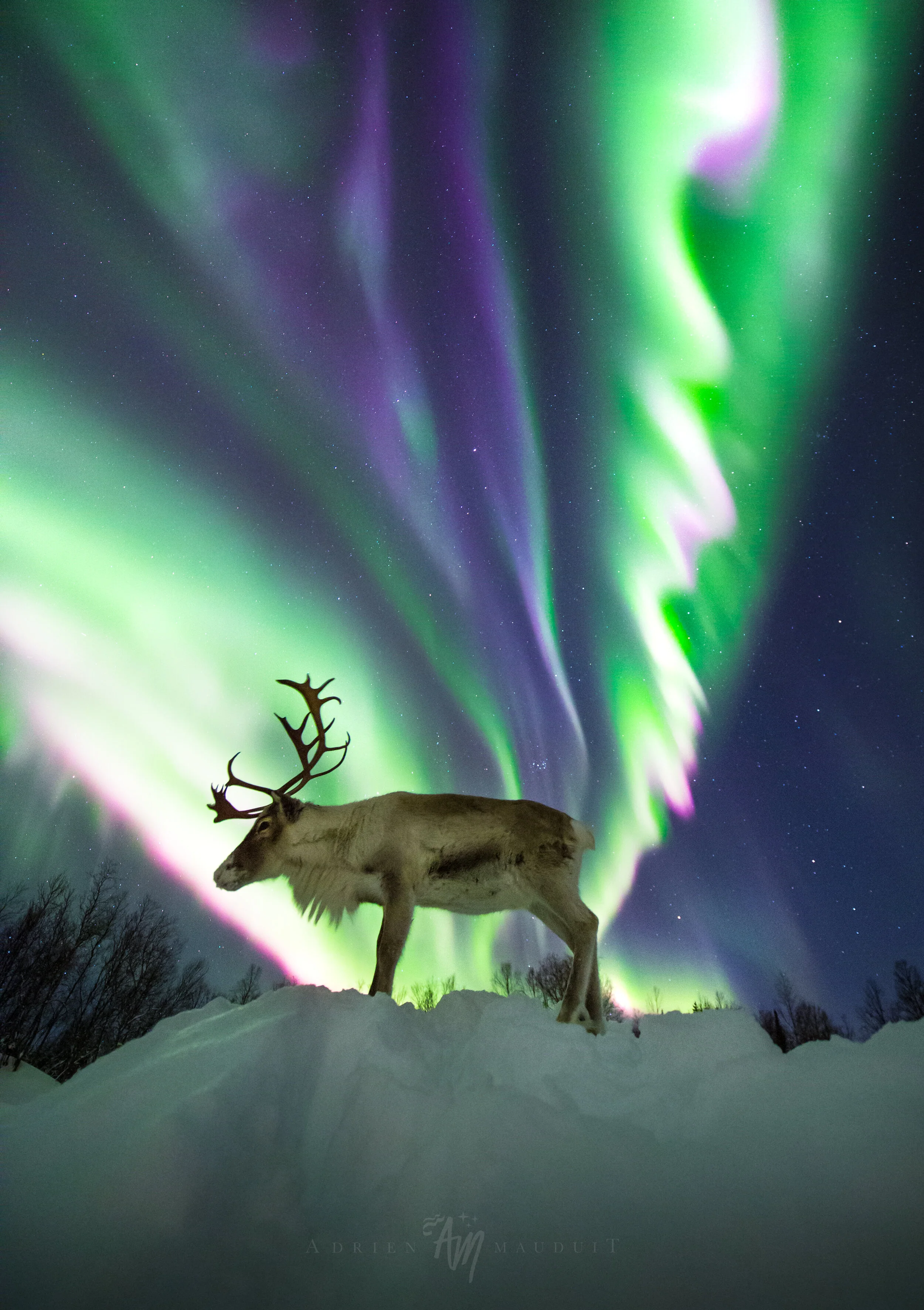
Reinulf under the aurora This picture was also taken from the Aurora Borealis Observatory in late February. I had waited a year to get such a shot. Our reindeer Reinulf is a semi-wild animal in a big enclosure. I am the one feeding him so he likes to hang around me, but to be able to get him to freeze for a split second and have him stand in the right direction requires extreme patience. The result is absolutely stunning. There are other photos of reindeers under the aurora out there, but not with that much details and colors in the lights, or the reindeer not being on a leash.
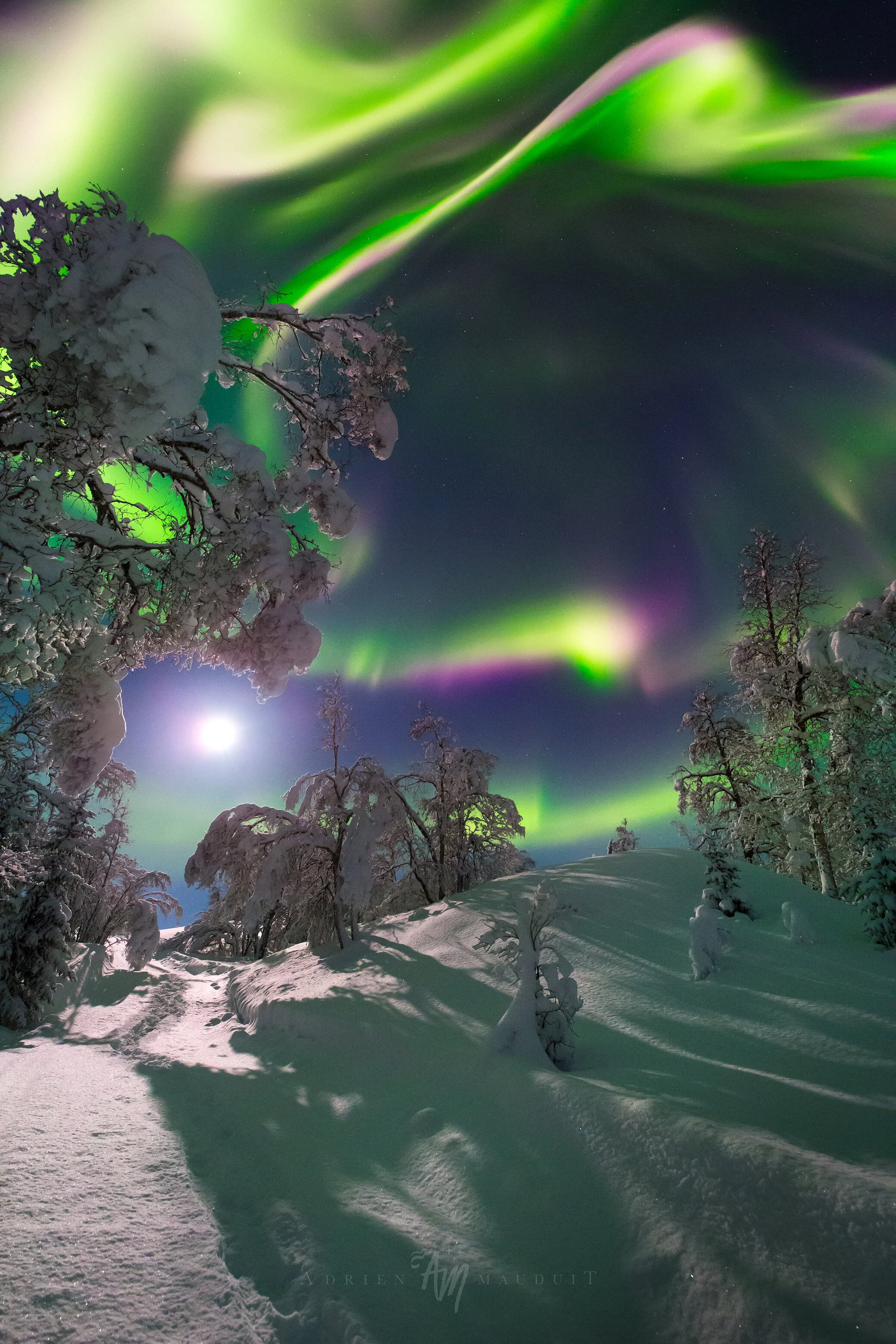
Aurora Moon Flower This picture has a special place in my heart because it has everything a good aurora picture needs: a good composition, vibrant colors, a stunning dynamic range created by the moon and shadows of the trees, lots of powdery snow and not a cloud. Did I mention that this picture was taken right behind the observatory, one minute walk into the woods? Yes the observatory is the place to be! I love how the aurora also creates a flower shape that seems to engulf and cover the whole sky, almost like a green and pink umbrella!
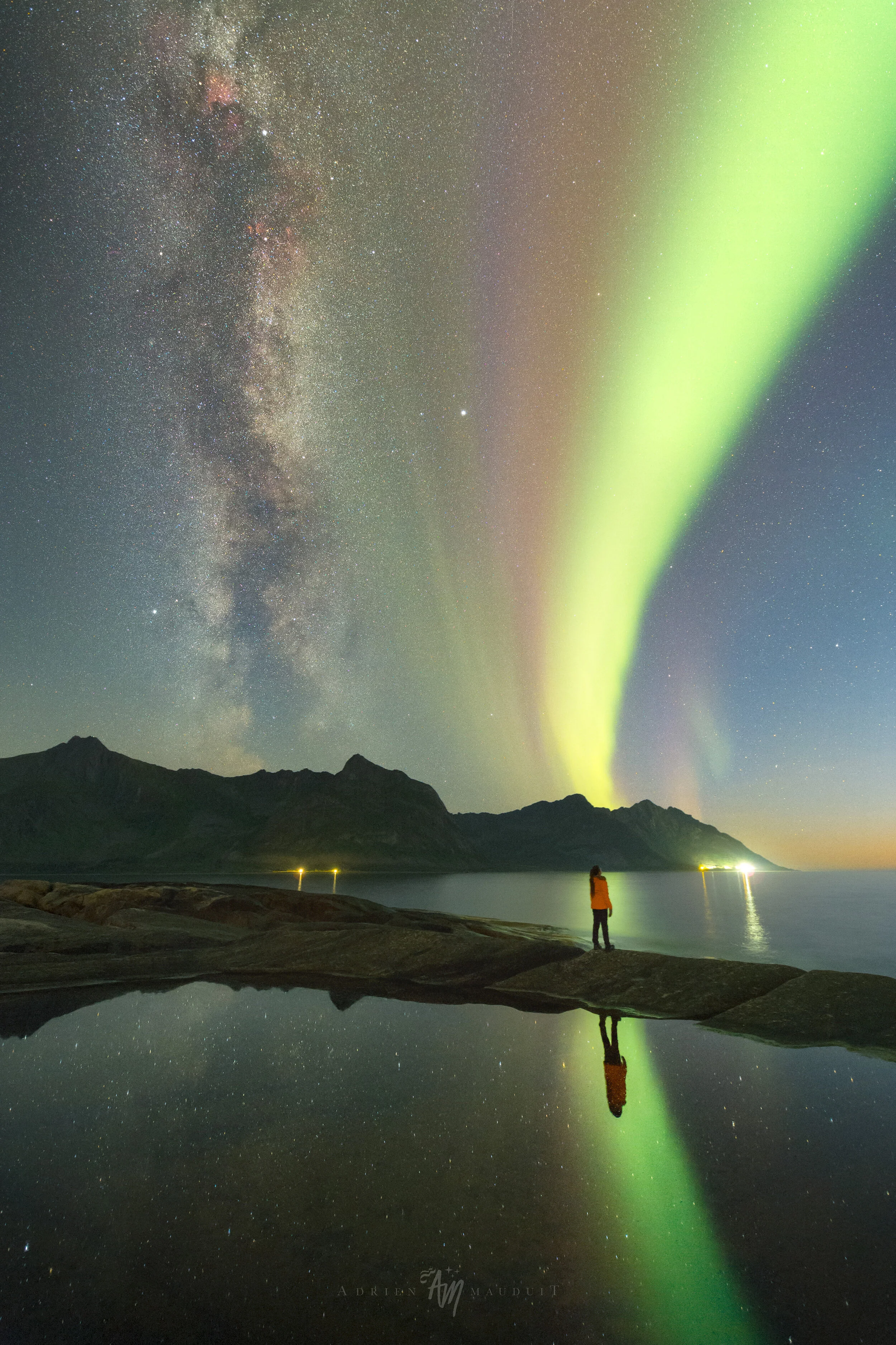
Lady reflections Much obliged. This shot wins the contest hands down and is my favorite overall shot of this year. It might even be my favorite shot of all time and here’s why. To get a shot like this you need loads of patience to wait for the right weather and aurora conditions but also the right set of skills and gear. To get the milky way so defined, sharp and detailed you need to track the sky with a tracker device but not too much so that the foreground is still sharp. The aurora usually is much brighter than the milky way so you can’t take a picture like this with a 17 second shutter speed when the aurora is bright. The lady in the foreground had to stand right in this thin auroral band. In short anything could have gone wrong. But it didn’t and what a result! Visually the composition is extremely pleasing to the eye. There’s almost a perfect symmetry between milky way and aurora, the general colors of the pictures are vibrant and widespread (taken in the deep astronomical twilight, so you still get orange on the far horizon). And the reflection is on point, hence the name of the picture. That’s why September is my personal favorite month of the year to photograph the aurora…