AN ARTIST IN RESIDENCE AT CAPITOL REEF NATIONAL PARK
by Imma
When I decided to pursue a career in landscape and nature photography I already had in mind to combine my biology background, my conservationist leanings and my passion for photography into this art form. As I delved into all my favorite things to capture in nature, I started to feel more and more interested in night photography as it offered a chance to shoot scenes that few ever see and are truly inspiring.
Most of my astrophotography is taken in New Jersey where I live. However, in 2018 I was fortunate to be selected as a volunteer at the Palms Spring Photo festival. This was an excellent opportunity as I had a chance to network with other professionals and learn about accessing grants and in particular the Artist in Residence Programs run by the US National Park Service. Just after the festival, I visited Joshua Tree National Park and it was there where my long-term project was conceived and initiated. My main goal became to capture and document those inspiring landscapes under the night sky as a way to raise awareness and educate others about light pollution as another form of pollution affecting animals and ecosystems in all sorts of ways.
Capitol Reef National Park is in Utah's south-central desert and the closest town is Torrey, just eight miles west of the park’s visitor center, on Highway 24. The area is named for a
line of white domes and cliffs of Navajo Sandstone where one of them resembles the United States Capitol building and the word Reef refers to the rocky barrier making passage difficult.
The park encompasses the spectacular Waterpocket Fold, a wrinkle in the earth's crust that is 65 million years old and extending almost 100 miles, with layers of white sandstone domes, canyons and striking rock formations. Among the park's geological sights are: Chimney Rock pillar, The Castle, Capitol Dome, Hickman Bridge Arch, Cassidy Arch, The Golden Throne and in the north the towering Entrada Sandstone monoliths of Cathedral Valley. In addition, the area is full of history: from the petroglyphs etched in sandstone by the Fremont people who inhabited the land nearly 1,000 years ago to the small Mormon town of Fruita inside the park with more than 2,500 fruit trees, some of which were originally planted by pioneers. Additionally, Capitol Reef is a Gold Tier International Dark Sky Park with some of the best night sky viewing opportunities of the western national parks and as part of this designation, staff and volunteers perform ongoing monitoring of night sky conditions throughout the area. The park's commitment to reducing light pollution and educating the public about the night skies is also demonstrated by offering one annual Artist In Residence program exclusively dedicated to night photography.
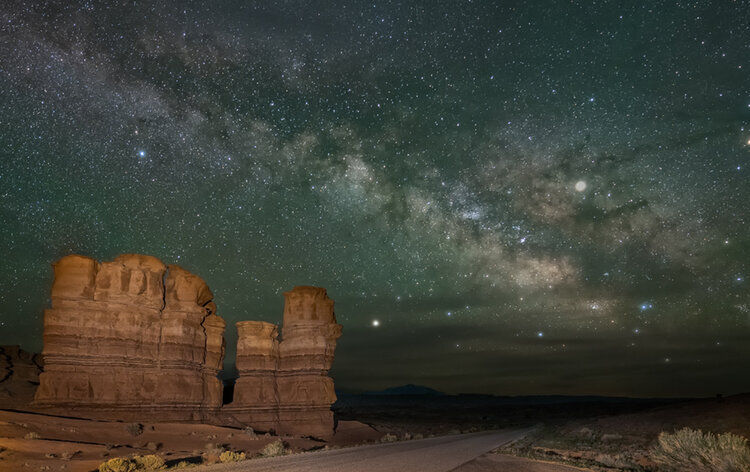
Hoodos are thin spire of rock protruding from the bottom of an arid drainage basin.
Capitol Reef’s program and their goals were exactly what I was looking for to develop my own project so I was delighted to have been selected as the 2019 recipient. During the 20 day period my residency lasted, I was able to explore in-depth the park to identify some spectacular foregrounds from extensive or intimate vistas, to rock formations, to hoodoos and to historic buildings. Cloudy days were dedicated to wildlife observations, in particular, the very cute yellow-bellied marmots, mule deer and birds like the black-chinned hummingbird or the mountain bluebird. I arrived at Capitol Reef during the new moon and as soon as I had unpacked my gear, I headed out to explore the one-room schoolhouse, constructed by Mormon Fruita residents in 1896, which also served as a community center. The weather forecast for the
following night was perfect for the amazing back-country trip to the Cathedral Valley where I spent all night in perfect solitude with the stars admiring the Temple of the Sun and the Temple of the Moon. The third night was dedicated to the popular Chimney Rock, an eroded pillar of red sandstone. Subsequent nights included visits to Pectol’s Pyramid (a sandstone monolith just off the main road) and the Gifford’s barn in Fruita, drives along the Notom-Bullfrog Road, and some star trails captured at Twin Rocks and at the Wingate Sandstone capping The Castle. As the nights passed by, the moon’s presence wasbecoming more noticeable but there were still some opportunities available to photograph the Milky Way
closer to moonset at Goosenecks Overlook or at the orchards by the visitor center. On my one “day-off”, I decided to drive to the nearby Goblin Valley State Park, another jewel within Utah’s dark sky region.
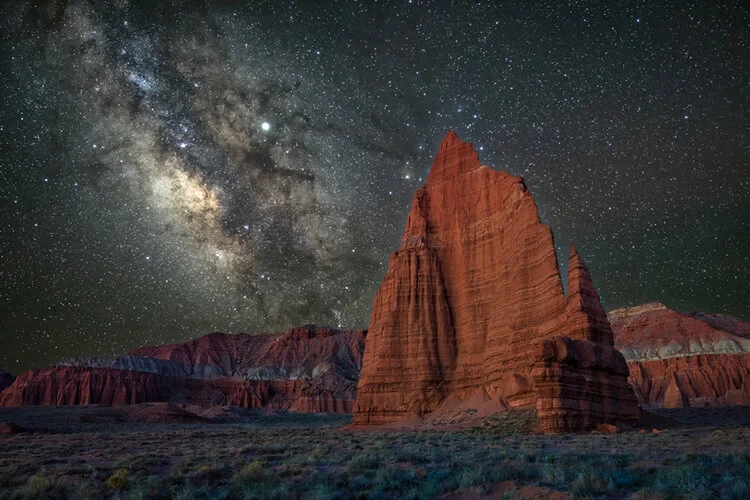
Temple of the Moon, an impressive sandstone monolith found in the back-country Cathedral Valley area
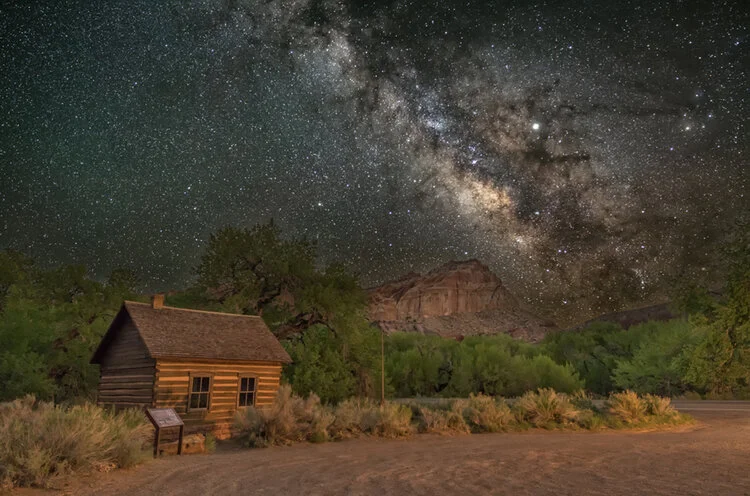
Fruita schoolhouse constructed by Mormon residents in 1896, which also served as a community center.
All Artists in Residence are considered volunteers for the National Park Service and therefore I was able to attend some of the training programs set up to educate the public about all aspects of the park including management, its inhabitants and their history and also about its geological and biological relevance. One of my tasks as a volunteer included a presentation of my work as part of the Evening Program at the camp
ground amphitheater. A second lecture was also hosted by the Entrada Institute, a nonprofit organization dedicated to preserving and celebrating the natural, historical, and cultural heritage of the Colorado Plateau.
Even though my stay was for twenty days and I was able to accomplish my photographic goals, I felt it was over too soon. One could easily spend several months at the park and still find new areas to explore so I am left with no other choice but to go back. And last but not least, my sincere and deepest gratitude goes to all the staff members and volunteers at Capitol Reef National Park who made my stay so unforgettable and to the Entrada Institute for their monetary support.
BIO
Born in Barcelona Imma Barrera is a landscape and nature photographer based in Metuchen NJ. She is a biologist but also a graduate of NY Institute of Photography and has exhibited her photography in a number of galleries worldwide and won several awards. One of her favorite subjects to photograph is the Milky Way and was selected as the 2019 Capitol Reef National Park's Artist-in-Residence for her night sky photography, In addition, she was shortlisted in the Landscape category of the 2019 Sony World Photography Awards’ Professional competition with her series “Under the Night Sky”. She is involved in educational programs about photography and seminars to raise awareness about the need to protect our natural treasures. She has published a photography book about night photography in NJ and NY and is currently working on a book about the night skies at several US national parks. Her work can be seen on
her website www.imma.photo or on instagram @imma.photo.